

In the steel industry, the operating environment for equipment can be described as "hardcore of the hardcore"-characterized by high temperatures, heavy dust, and continuous operation, with none of these factors ever absent. As a critical component connecting fluid lines to rotating machinery, the rotary joint-despite its compact size-acts like a "veteran behind the scenes"; should it falter, the entire production line could be compromised. So, under such demanding operating conditions, exactly what requirements must a rotary joint fulfill?
First and foremost, its high-temperature resistance must be impeccable. During steel production-whether in continuous casting, rolling, or furnace heating systems-operations invariably rely on high-temperature media, such as circulating steam, thermal oil, or even cooling water. Operating in such an environment, a rotary joint is akin to a person "working right next to a furnace"; if its materials lack heat resistance, it is highly susceptible to seal aging, deformation, or even catastrophic failure. Consequently, the selection of high-temperature-resistant sealing materials-such as graphite or metal-to-metal sealing structures-is typically mandatory to ensure stability under extreme heat.
Secondly, sealing performance must be stable and reliable. Most equipment in the steel industry operates continuously-running for twelve hours or more at a stretch, or even around the clock without pause. Should a rotary joint develop a leak, it not only impairs equipment efficiency but also poses significant safety hazards. In this context, sealing performance can truly be considered the rotary joint's "lifeline." A high-quality rotary joint must remain absolutely "leak-proof" while simultaneously enduring the combined stresses of high temperature, high pressure, and high-speed rotation.
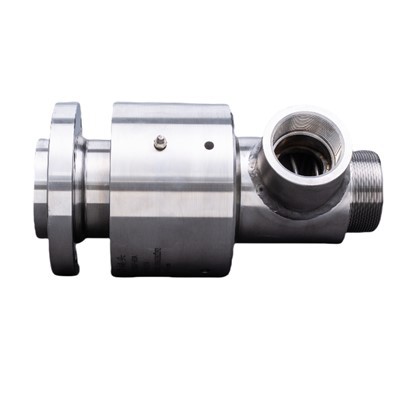
Next come impact resistance and wear resistance. Steel production sites are characterized by intense vibration and frequent load fluctuations; the equipment is essentially "running a marathon year-round," never enjoying a moment of respite. If the internal bearings and sealing surfaces of a rotary joint lack sufficient wear resistance, they are highly prone to failure resulting from prolonged friction. Therefore, wear-resistant materials-such as cemented carbide or silicon carbide-are commonly employed to enhance the component's overall service life.
Furthermore, the ability to handle complex media is crucial. In the steel industry, the circulating fluids are rarely just clean water; they may contain mill scale, impurities, or even corrosive chemical agents. This demands that the rotary joint not only be capable of "withstanding the heat" but also be "tough enough to take a beating," possessing inherent resistance to both corrosion and contamination to prevent internal clogging or structural damage.
Finally, one point that is often overlooked is the ease of installation and maintenance. Steel manufacturing enterprises prioritize efficiency; whenever equipment requires servicing, time translates directly into cost. If a rotary joint features a complex structure that makes disassembly and reassembly difficult, the burden of maintenance increases significantly. Consequently, products characterized by sound structural design-specifically those that allow for easy replacement of seals-are often the most sought-after.
Finally, operational stability and service life are of equal importance. In the steel industry, the primary concern is not the cost of equipment itself, but rather the frequency of malfunctions. A high-quality rotary joint should be capable of operating stably over extended periods, thereby minimizing the need for downtime and repairs. Simply put, the goal is to minimize "fuss"-allowing the equipment to perform its duties reliably and without interruption.
To offer a simple analogy: if one views the entire steel production line as a high-speed machine, the rotary joint serves as one of its critical gears. It may not be the most conspicuous component, but it must be the most reliable. Should this particular gear fail, the entire machine will grind to a halt.
In summary, the steel industry's requirements for rotary joints can be distilled into the following key criteria: high-temperature resistance, superior sealing performance, wear resistance, corrosion resistance, ease of maintenance, and a long service life. Selecting the right product is akin to equipping the machinery with a "stable heart"; conversely, making the wrong choice can become the source of significant operational hazards. Therefore, when selecting a model, it is imperative to take actual operating conditions into account; one must look beyond price alone and prioritize performance and compatibility.