

Rotary Joint for Compressed Air
Mr. Shang Xuesheng founded the company in 1999. At that time, China was still mainly importing rotary joints from abroad, He saw the development prospects of rotary joints in China and was determined to become an excellent rotary joint manufacturer in China.
To develop our own products, Shang established the company, "Shandong Changsheng Rotary Joint Co., Ltd" and went on to design joints for a wide variety of applications, including plastic machines, textiles equipment, metal-steel production lines. As a result of our hard work and dedication over 20 years, our sales marked a record about 5 million US dollars in 2023. Today, our financial situation is in a comfortable place, with the current total manpower just over 50.
Why choose us?
Innovation
We continuously refine our products and use the most modern materials and production methods. Every task we are given by our customers, we see as a challenge and motivation to develop the best solution possible.
Service
We offer our customers full support throughout the whole lifetime of the product. All around the globe, our highly skilled employees are happy to help you with their expertise.
Quality
We set the standards for excellent quality. These standards will make us grow in a sustainable and profitable manner and strengthen our leadership in technology.
Reliability
Our customers can always rely on our products and our employees. These are the quality standards which we set for our products and for ourselves.
-
![Rotary Union for Water and Air]() Rotary Union for Water and Air● Fluid: Water /Air/Hydraulic Oilread more
● Materials of Housing: Copper Alloy/Stainless Steed
● Seal Structure: Sealing Ring Seal
● Housing Connection: Thread -
![pneumatic rotary union for air]() pneumatic rotary union for air●Fluid: Water, Oilread more
●Materials of Housing: Carbon Steel / Stainless Steel
●Seal Structure: Multi-springs Balanced Mechanical Seal
●Housing Connection: Thread/ Flange -
![Rotary Joint Air]() Rotary Joint Air●Fluid: Water, Oilread more
●Materials of Housing: Carbon Steel / Stainless Steel
●Seal Structure: Multi-springs Balanced Mechanical Seal
●Housing Connection: Thread/ Flange -
![standard air rotary joint]() standard air rotary joint●Fluid: Water, Oilread more
●Materials of Housing: Carbon Steel / Stainless Steel
●Seal Structure: Multi-springs Balanced Mechanical Seal
●Housing Connection: Thread/ Flange -
![Rotary Air Joint]() Rotary Air Joint●Fluid: Water, Oilread more
●Materials of Housing: Carbon Steel / Stainless Steel
●Seal Structure: Multi-springs Balanced Mechanical Seal
●Housing Connection: Thread/ Flange -
![Rotary Joint For Air]() Rotary Joint For Air●Fluid: Water, Oilread more
●Materials of Housing: Carbon Steel / Stainless Steel
●Seal Structure: Multi-springs Balanced Mechanical Seal
●Housing Connection: Thread/ Flange -
![Rotary Pipe Union]() Rotary Pipe Union●Fluid: Water, Oil ●Materials of Housing: Copper Alloy / Stainless Steel ●Seal Structure: Mechanical Seal ●Housing Connection: Threadread more


What is Rotary Joint For Compressed Air
As a swivel joint between the stationary and moving parts of pneumatic materials, they ensure a reliable flow of compressed air, gases, and vacuum. Pneumatic rotary joints are often used between a compressed air pipe and a rotating drum.
Benefits of Rotary Joint For Compressed Air
Efficiency and functionality
Air Rotary Unions are engineered to facilitate smooth operation and to increase the efficiency of machinery. They enable the transfer of media without the need for detaching hoses or tubes when the equipment must rotate, which reduces the downtime and potential for human error, significantly improving operational flow. Additionally, the ability of these unions to handle multiple media types through multi-passage designs increases the functionality of a single unit, streamlining the process and making complex rotations and operations possible. This adaptability ensures that machines can work faster, longer, and more reliably, directly contributing to increased productivity.
Quality and durability
The construction of Air Rotary Unions involves high-quality materials and precision engineering. Stainless steel, aluminum, and engineered polymers are commonly used, selected for their ability to withstand the stresses of industrial environments, such as exposure to high pressures, corrosive substances, and extreme temperatures. The seals within the unions are crafted from robust materials that can endure wear and maintain integrity over time, which is imperative in preventing leaks and ensuring that the unit functions correctly. These materials, combined with advanced manufacturing techniques, result in a product that is not only reliable but also durable, leading to a longer lifespan and reduced need for replacement or repair, thus ensuring consistent production quality over time.
Cost-effectiveness
Implementing Air Rotary Unions within industrial machinery is a cost-effective move. Due to their design efficiency and the high-grade materials used in their construction, these unions have lower maintenance requirements and longer service intervals. This reduces the costs associated with downtime and frequent servicing. Moreover, their durability means that equipment managers incur fewer replacement costs over the machinery’s lifetime. By optimizing operational time and minimizing both direct and indirect costs, Air Rotary Unions represents a smart investment for industries looking to maximize the value of their equipment and processes.
Rotary joints are used to transport steam, pressure, air, and other media. It is a sealing device that connects the gas input from the pipeline to the rotating equipment and then discharges. Pneumatic swivel unions work by swirling compressed air through a fixed point without leaking. A rotary union has two main components: the rotor and the stator. The rotor is the rotating element mounted on the shaft of a rotating machine, while the stator is the stationary part connected to a compressed air source. The rotor and stator contain channels through which compressed air flows.
When the machine turns, the rotor turns with it. The compressed air flowing through the channels in the stator is then delivered to the channels in the rotor without any leakage. Pneumatic swivels can deliver up to 10,000 psi of compressed air and can rotate at up to 10,000 rpm.
Simple rotary joints are divided into one-way flow type and two-way flow type. The one-way flow type does not use an inner tube, and the liquid enters through one end and exits through the other end. The two-way flow type has two forms: Inner tube rotation and inner tube fixed. The inner tube rotary type is mostly used for gas transmission.
There is a combined rotary joint whose working principle and structure are based on a pneumatic rotary joint and an electric slip ring. Electric slip rings are used to transmit electricity or signals. The functional parts are the stator and rotor. Through the contact of the stator brush wires with the rotor rings, rolling friction conducts current between the two elements. The electric ring can be composed of multiple metal rings to provide multiple power supplies.
Evolution and Technological Advancements in Rotary Joint For Compressed Air
The growth and evolution of Air Rotary Unions have been shaped significantly by advancements in technology and materials science. Modern air rotary unions are meticulously designed using advanced engineered materials and sophisticated sealing technologies, providing them the ability to withstand high pressures, temperatures, and rotational speeds.
The inclusion of high-performance materials like stainless steel, carbon-filled Teflon, ceramics, and other proprietary composites has substantially boosted the performance, durability, and lifespan of Air Rotary Unions. Technological advancements have also spurred the development of various designs to cater to a broad spectrum of industrial needs – from single passage units for simplistic media transfer applications to multi-passage units handling multiple simultaneous inputs and outputs.
Furthermore, advancements in Computational Fluid Dynamics (CFD) and Finite Element Analysis (FEA) tools have allowed for more precise designs and custom solutions tailored to unique industry requirements. The ability to predict and analyze the performance of the union before manufacturing has improved efficiency and longevity, and significantly reduced costs.
Over the years, innovations in sealing technologies have been instrumental in overcoming leakages, one of the most common problems faced by rotary unions. From the early days of simple sealing mechanisms, the development journey has seen significant milestones such as dynamic multi-contact sealing systems, improving the operational reliability of air rotary unions in demanding operational conditions.
This continual evolution and relentless pace of innovation within the field of Air Rotary Unions stands testament to the importance of these components in modern industrial applications. It’s a reflection of the drive to enhance efficiency, reliability, and longevity to fulfill the ever-increasing demands of industrial processes.
Installation location
Determine the installation location of the pneumatic swivel joint or swivel joint, and ensure that it is properly connected to the relevant equipment or pipes.
Connection method
According to the specific model and requirements, select the appropriate connection method, usually threaded connection, flange connection, quick connector, etc.
Connect the pipe
Connect the pneumatic rotary joint or swivel joint to the corresponding gas pipe. Make sure the connections are tight and well sealed to avoid gas leakage.
Control the gas supply
Control the supply and stop of gas through external control devices such as valves or pneumatic control systems. Adjust gas pressure and flow as needed and ensure stable gas supply.
Test run
After the installation is completed, conduct a test run to ensure that the rotary union pneumatic or rotary joint can smoothly transmit the gas medium and rotation signal, and check whether there are any abnormalities or problems.

What are the Difference Between Rotary Joint For Compressed Air and Hydraulic Rotary Union
Normally, the pneumatic rotary union and the hydraulic rotary union are both belong to the rotary unions that allow the transfer of fluids, but they are designed to transfter different types of fluids pass by.
The pneumatic rotary union is used to transfer compressed air or other gases between a stationary source and a rotating component. These types of rotary unions are commonly used in pneumatic tools, robotics, and automation equipment. They are typically designed to operate at high speeds and to withstand high pressures. Pneumatic rotary unions may have multiple channels to allow the transfer of multiple gases or to allow for simultaneous power and signal transmission at same time.
The hydraulic rotary union, in one word, is designed to transfer hydraulic fluid between a stationary source and a rotating component. Hydraulic fluids are typically used to power heavy machinery, such as construction equipment and factory machinery. Hydraulic rotary unions must be designed to handle high pressures and high flow rates. They may also have multiple channels to allow for the transfer of multiple fluids, such as power, signals, and cooling fluid.It can be design as a combined slip ring.
Both pneumatic and hydraulic rotary unions typically have a seal to prevent fluid leakage, and they may also incorporate bearings to support the rotating component and reduce friction. The design of the rotary union will depend on the different requirements of the application, including the types of fluid, the pressure and flow rate, and the speed of rotation.
Key Components of Rotary Joint For Compressed Air
Seals
Seals are arguably the most critical part of a pneumatic rotary union. They act as a barrier, preventing the leakage of pressurized air or gas while allowing the rotating part to move freely. In this way, seals ensure that the media retains its pressure, temperature, and flow rate, thereby maintaining the machinery’s performance.
The design, material, and wear resistance of the seals are integral to the longevity and efficiency of the rotary unions. Seals need to be engineered from robust materials able to withstand the pressure of the transmitted gases, as well as resist the wear and tear from constant interaction with the rotating parts.
Bearings
Bearings are another pivotal component in pneumatic rotary unions. They support the rotating components and allow precise rotation by reducing friction between the moving parts. This reduction of friction is crucial to prevent unnecessary wear and tear, and overheating, and to ensure the smooth operation of the rotary union.
Depending on the application, different types of bearings may be used. For instance, roller bearings might be used in high-load applications while ball bearings might be used in low-load but high-speed applications.
Housing
Housing, the outer case of the rotary union, is responsible for providing the sturdy structure within which the other components operate. It protects the internal parts from external factors such as physical damage, dirt, or moisture while simultaneously ensuring a robust connection between the stationary and rotating components.
The material of the housing must be durable and able to withstand the environmental conditions in which the machine operates. The housing is frequently made of metal, such as stainless steel or aluminum, depending on corrosion resistance, weight, and structural stability requirements.
How to Choose the Right Rotary Joint For Compressed Air
Pressure Range
The rotary union must be capable of withstanding the pressure range of the gas being transmitted. While different unions cater to different pressure ratings, it is crucial to choose one that aligns with the specific application’s pressure requirements. Inadequate pressure management can lead to seal failure, gas leakage, and reduced efficiency of the machinery.
Flow Capacity
Flow capacity, or the volume of gas that can pass through the rotary union within a given period, must also be considered. Selecting a union with the appropriate flow capacity will help ensure that the machinery receives the necessary gas supply for optimal performance. A mismatch in flow capacity could lead to insufficient supply or pressure buildup, both of which can impair the equipment’s functionality and performance.
Temperature Range
The ability to handle the temperature range of the transmitted gas is another essential aspect of rotary union selection. Each rotary union is designed to cope with a specific temperature range; thus, it is crucial to identify the one that matches the application’s operational temperatures. Overlooking this factor can expose the seals, bearings, and other internal components to excessive wear and potential failure.
Compatibility With Different Gases
A rotary union must be compatible with the type(s) of gas it will cater to, given that different gases exhibit varying characteristics. Material compatibility of seals and housing should be carefully evaluated to avoid premature wear and chemical reactions with gases being transmitted.
Application-specific Factors
Some applications may require specialized features or adjustments. For example, high-speed rotary unions for fast-rotating machinery, or high-pressure rotary unions for applications with extreme pressure. In the case of multiple passage rotary unions, the application might necessitate the transmission of different gases with varying pressure and temperature requirements simultaneously.
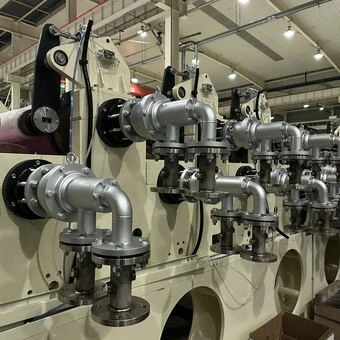
Our Factory
Shandong Changsheng Rotary Joint Co., Ltd. is an enterprise integrating scientific research, design and manufacturing of rotary joints, metal hosesand corrugated compensators. lts products are mainly used in rubber,plastics, steelmaking, papermaking, chemical and other industries.
Equipped with machining centers, CNC lathes and other professional facilities, the company organizes production, sales and services inaccordance with lS09001 quality standards.


FAQ
As one of the leading rotary joint for compressed air manufacturers and suppliers in China, we warmly welcome you to buy rotary joint for compressed air for sale here from our factory. All customized products are with high quality and competitive price. Contact us for quotation.
rotary union for air, air rotary joint, rotary joint air